Out now 🔥
The State of AI in Pharma: Trends, Benchmarks, and What's Next
Get our exclusive market research, featuring insights from 200+ leaders across the EU, US, and Asia.
AuthorTeodora Corbu
CategoryPharma Innovation

HCP personalisation is more than greeting users and letting them select a few preferences. Personalisation can evolve from simple customisation to automated segmentation and, eventually, intelligent recommendation systems.
HCP personalization in one of pharma’s most discussed digital priorities, and one if its most inconsistently executed. This article gives a clear, practical framework to show where your organisation stands. It explains what it takes to move forward. It also shows why the order matters.
HCPs are disengaging from portals that broadcast rather than personalise. This section reviews the commercial cost of one-size-fits-all digital experiences.
It explains what today’s HCPs expect. It also outlines structural reasons holding most pharma organisations back. These include fragmented ownership, siloed data, and compliance-first architecture.
Each level of personalisation is defined by its business outcome, technical needs, and most common failure. This provides a shared language for where you are and where you need to go.
Level 1: Segmentation-based personalisation | Level 2: Behavioral personalisation | Level 3: Predictive personalisation |
Rules-driven content tailored to specialty, geography and role. The entry point most organisations haven’t fully mastered. | Content that adapts in real time to what HCPs do on the portal. Requires unified data, CRM integration, and a consent-aware architecture. | AI and ML models that anticipate HCP needs before they’re expressed. High potential, significant regulatory and governance complexity in the pharma context. |
Before your next portal investment, establish which level you’re actually operating at, not which level your roadmap assumes. The gap between the two is where most HCP personalisation strategies quietly fall.
Get our exclusive market research, featuring insights from 200+ leaders across the EU, US, and Asia.
Open any pharma digital strategy document from the last five years and you’ll find the same commitment: personalised experiences for healthcare professionals. Relevant content, the right message at the right time. A portal that works for the HCP, not against them.
Now, in most cases, an oncologist from Milan and a GP from Manchester will see the same homepage, the same featured content, and, generally, have the same experience.
The gap between HCP personalisation as a strategy and HCP personalisation as a lived experience is one of the most consequential, and least discussed, disconnects in pharma’s digital evolution.
The gap is structural: ownership of HCP personalisation is split across medical, digital, and commercial teams, each with different priorities and different definitions of what “personalised” even means.
The cost of this is real. HCPs are spending less time on portals that don’t serve them. They return less often, engage less deeply, and increasingly look elsewhere for the clinical and scientific information they need.
In a landscape where the in-person rep visit is in long-term decline, the portal is no longer a support channel, but the primary relationship. When it fails to personalise, the relationship suffers.
In this article, we offer a practical framework for pharma leaders who are responsible for closing that gap. We define three levels of HCP personalisation and map what each level requires commercially, technically, and organisationally.
The cost of irrelevance is not abstract either. According to the Veeva Pulse Field Trends Report (May 2025), content-driven HCP engagements more than double new patient treatment starts. Using the right content also shortens the time between meetings by up tp 25% and increases the likelihood of a follow-up by up to 20%. The inverse is equally true: generic, poorly targeted engagement does not merle underperform, it erodes the relationship.
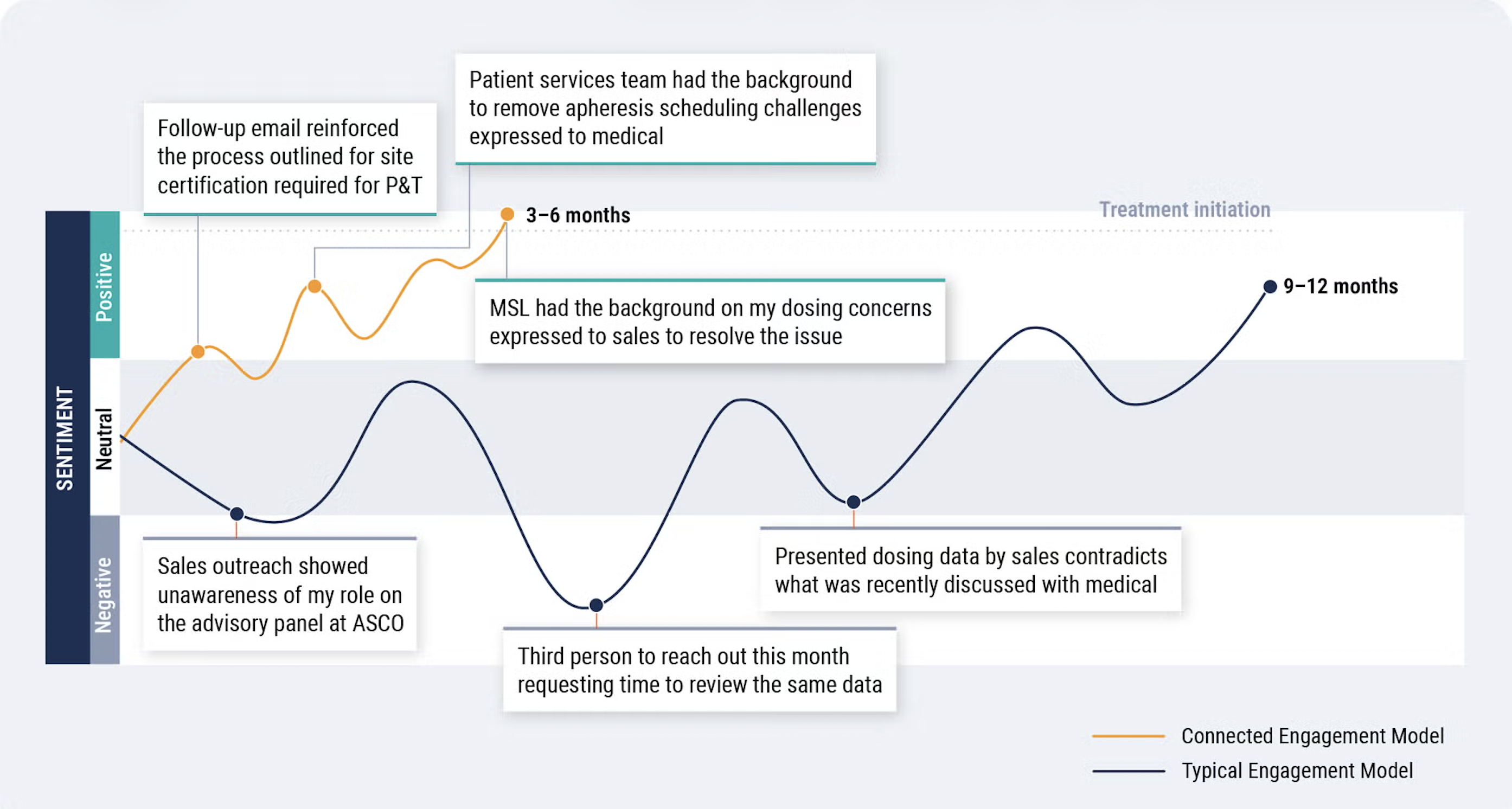
HCP personalisation is not a feature enhancement. It is the difference between a portal that supports commercial outcomes and one that merely exists.
Every HCP who visits a pharma portal also uses Spotify, LinkedIn, or Amazon. They are accustomed to experiences that adapt to them, that remember what they engaged with, surface what they are likely to need next, and do not waste their time with content that has nothing to do with them.
This benchmark travels into professional life. The gap between the digital experiences HCPs expect as consumers and what pharma actually delivers is a credibility gap.
A Deloitte survey captured this: 80% of pharma executives are satisfied with their current engagement strategies, while only 35% of HCPs believe that customer-facing resources are meeting their needs.
When a portal feels static and indifferent to who they are, HCPs notice in the friction they feel and the disengagements that follows. The expectation of relevance is now a baseline, not a differentiator. Failing to meet it is no longer neutral, it actively damages trust.
Understanding why HCP personalisation lags behind its strategic ambition requires an honest look at how pharmaceutical companies are structured. According to McKinsey’s Digital Quotient analysis, pharma lags behind every major industry in digital maturity, second only to the public sector.
And research from Graphite Digital found that 77% of pharma respondents reported their omnichannel strategies had little to no impact on customer engagement, with implementation failures most commonly attributed to data silos, lack of clear ownership, and slow approval cycles.
The barriers are rarely technological. The tools exist, so does the data. What is missing is alignment. More specifically, a shared definition of what HCP personalisation actually means across the functions responsible for it.
Get access to a comprehensive audit and in-depth analysis of 28+ HCP portals across Europe and the US.
HCP personalisation is the practice of tailoring digital portal content, experiences, and communications to the specific attributes, behaviours, and predicted needs of individual healthcare professionals, moving beyond broadcast to relevance, and beyond segmentation to genuine individual-level adaptation.
This is the entry point. It’s built on a straightforward principle: different HCPs have different needs, and those differences can be predicted from static attributes: specialty, geography, role, product access, regulatory jurisdiction, language.
Rules-based logic uses there attributes to determine what content an HCP sees when they arrive at a portal. An oncologist in France sees different content from a GP in the Netherlands. A prescriber with access to a specific product sees branded materials; one without access sees disease awareness content instead. The portal adapts to who the HCPs are, not just what they do.
Why this matters commercially
The commercial case for getting Level 1 right not is not subtle. Indigene’s 2024 HCP Digital Affinity Report found that digital engagement preferences vary dramatically across specialties. Cardiology, endocrinology, and internal medicine, for example, show significantly higher digital affinity than anaesthesiology, radiology, and surgery.
A portal that serves identical content across these groups is not just inefficient, it’s actively misaligned with how different HCPs want to engage.
60% of HCPs report feeling overwhelmed by pharma’s digital engagement, due to a lack of contextual relevance.
This is the problem Level 1 personalisation directly solves. When personalized content is matched to specialty and clinical context, the signal-to-noise ratio improves immediately. HCPs spend less time filtering irrelevance and more time engaging with content that speaks to their actual practice.
The commercial result is sharper launch messaging, more effective lifecycle management communication, and a portal that earns return visits rather then discouraging them.
What good looks like
A well-executed Level 1 portal delivers a distinct experience for each HCP segment from the moment of login: a specialty-specific homepage, a content feed filtered to the relevant therapeutic area, regulatory-appropriate materials by country, and branded or unbranded routing determined by product access status.
Most common failure
Organisations build elaborate specialty taxonomies and routing logic, only to discover that the content library is not differentiated enough to serve them. Fifteen HCP segments, three pieces of relevant content each. The segmentation architecture exists; the content strategy to support it does not. The fix is to start with fewer, better-defined segments and build content depth before building segment breadth.
Level 1 personalisation answers a static question: who is this HCP? Level 2 answers a dynamic one: what is this HCP actually doing — and what does that tell us about what they need next?
Behavioral personalisation moves beyond fixed attributes to real-time and historical signals: pages visited, content downloaded, searches made, time spend on specific therapeutic areas, frequency of return visits, channel preference patterns.
Where Level 1 segments an HCP based on their profile, Level 2 adapts to their behavior, in ways that grow more accurate over time.
The commercial intuition behind Lever 2 is straightforward. An oncologist who has spent three exploring a specific mechanism of action is signaling something about where they are in the clinical decision-making process. A portal that recognises the signal, and surfaces relevant trial data, dosing information, or patient support resources in response, is not just more useful. It’s actively supporting the prescribing journey rather than broadcasting at it.
Why this matters commercially
The data on connected, contextually aware engagement is unambiguous. McKinsey research (cited above) confirms that omnichannel orchestration, which depends on behavioural data flowing across channels, generates up to 30% more engagement compared to single-channel campaigns.
When portal behaviour is invisible to the field team, and rep interactions are invisible to the portal, HCPs receive a fragmented experience. The opportunity cost of this disconnection is substantial and largely unmeasured.
What good looks like
Behavioural personalisation at Level 2 is built on a set of engagement signals that, when captured and interpreted correctly, reveal far more about an HCP's current needs than their specialty or geography alone.
Recency and frequency | Content depth | Search behaviour | Channel preference |
How recently and how often an HCP visits specific content areas, a proxy for current clinical focus or active prescribing decision. | Whether an HCP reads summaries or full clinical papers, a signal of engagement stage and information appetite. | What HCPs actively look for on the portal; often the most direct signal of current clinical questions or prescribing intent. | Whether an HCP engages via email, portal, or rep visit, enabling the next interaction to arrive through the channel most likely to be acted on. |
Together, these signals enable next-best content logic: a recommendation layer that surfaces what an HCP is most likely to need next, based on what they have already engaged with. This is a structured response to real behaviour, and it is the mechanism that makes a portal feel genuinely useful rather than merely available.
Most common failure
Most pharma organisations have the raw materials for Level 2 personalisation: CRM data, portal analytics, consent records, and channel preference data. What they lack is a function that owns the integration layer between them.
Level 3 is where HCP personalisation moves from responsive to anticipatory. Rather than reacting to what an HCP has done, predictive personalisation uses artificial intelligence and machine learning to forecast what they are likely to need next, before they search for it, request it, or ask a rep about it.
The underlying mechanism is a propensity model: a machine learning system trained on a combination of behavioural signals (portal engagement, content affinity, channel preference), commercial data (prescribing history, therapeutic area focus), and cohort patterns (how similar HCPs behave at equivalent points in their engagement journey). The output is a continuously updated prediction of the content, channel, and timing most likely to move each individual HCP forward.
Why this matters commercially
According to the Veeva Pulse Field Trends Report from May 2025, 80% of approved content is rarely or never used by field teams. Predictive AI’s core value is surfacing the right material at the right moment, not generating more.
One of the problems in pharma is a shortage of relevance. Predictive personalisation does not require more content to be created; it requires the right content to be surfaced from what already exists, at the moment when an HCP is most likely to act on it.
Governance requirements
Model cards and data lineage — documented records of what data trained the model, what it was designed to predict, and how its performance is monitored over time.
Bias audits — regular testing to ensure propensity models do not systematically disadvantage HCP segments based on specialty, geography, or demographic characteristics.
Human-in-the-loop review — AI recommendations reviewed by human experts before deployment, particularly for content that intersects with promotional or scientific claims.
Consent-aware data flows — architecture that enforces purpose limitation at design time, ensuring promotional and scientific data streams remain appropriately separated.
Most common failure
Organisations invest in predictive modelling platforms before they have unified the Level 1 taxonomy or built the Level 2 data integration layer. The result is a model trained on incomplete, inconsistent data, producing recommendations that the field team does not trust and the MLR team cannot approve. The fix is building the foundation before the model is ever trained.
The case for HCP personalisation has never been stronger, and the gap between that case and what most organisations have actually built has never been more visible.
Global healthcare advertising spend is projected to grow from $44.56 billion in 2025 to $67.87 billion by 2033. significant share of that investment will flow towards digital HCP engagement. The question is whether that investment will land on a foundation capable of making it work.
65% of pharma marketers are investing in AI-driven analytics for personalised HCP interactions, yet fewer than 205 of HCPs feel personally engaged.
97% of biopharma leaders say omnichannel personalisation is critical; only 10% have integrated data platforms to support it.
80% of HCPs still report receiving generic, impersonal communications from pharma; the execution gap has not closed despite years of investment.
HCP personalisation is becoming infrastructure in the same way that having a portal at all was once a differentiator and is now a baseline expectation.

Teodora Corbu
Marketing Specialist @Digitalya
Blending technology with creativity, Teodora turns cups of coffee into carefully written thoughts. With the power of the Oxford comma and a bit of magic, she brings words closer to people.
Efficient knowledge management is vital in the pharmaceutical industry, where quick access to accurate information can drive better decisions and collaboration. AI-powered chatbots are transforming this process, enabling pharma companies…
AI search engines are changing how HCPs find medical info. Learn how to make your HCP portal visible, engaging, and AI-ready in this guide.

From AI-powered HCP engagement portals to NLP-powered dashboards and medical affairs analytics, the right AI initiatives can create significant business value across the life sciences industry, particularly for pharmaceutical companies.…