Executive summary
Artificial intelligence is becoming a strategic capability across the pharmaceutical industry. From AI-powered healthcare engagement platforms to language dashboards used by medical affairs teams, AI supports pharma teams. It helps them find insights in complex data. It also helps them make better decisions.
However, the success of these initiatives depends heavily on selecting the right development partner.
In regulated environments like pharma, building AI solutions requires more than technical expertise.
Agencies must understand regulatory frameworks, data governance requirements, and how AI systems integrate with enterprise platforms used across medical, commercial, and regulatory teams.
Choosing a custom AI agency for pharma involves evaluating more than algorithms or models.
Leaders should assess whether a partner:
- has real experience with pharma workflows
- understands compliance expectations
- can build explainable AI tools that internal stakeholders can trust.
The right AI partner helps organizations move beyond experimentation.
Instead of isolated pilots, they enable scalable, compliant AI platforms that support long-term digital transformation across pharmaceutical operations.
What is a custom AI agency for pharma?
A custom AI agency for pharma is a development partner that designs and deploys AI solutions for pharma workflows, ensuring those solutions meet regulatory compliance.
Such agencies typically support initiatives like:
- AI-powered analytics dashboards for medical or commercial teams
- Natural language processing tools that analyze scientific or internal data
- AI platforms that improve engagement with healthcare professionals
- Data-driven systems that support operational or research decisions
Unlike general AI development firms, pharma-focused agencies understand regulatory constraints, compliance requirements, and the context of life sciences organizations.
Options for building AI solutions in pharma
Before evaluating external AI agencies, pharma organizations should understand the different ways AI solutions can be developed.
Building AI capabilities internally
Organizations with existing data science and software development teams may build AI platforms internally.
Advantages include:
- direct control over the development team
- strong internal knowledge of business processes
- closer alignment with internal stakeholders
However, building new AI capabilities internally can be challenging if the company lacks experienced AI engineers, product managers, and infrastructure specialists.
Creating and maintaining a dedicated AI development team requires significant investment and long-term planning.
Partnering with a specialized AI agency
Most pharmaceutical organizations choose to collaborate with specialized development agencies.
These agencies typically offer:
- multidisciplinary teams with AI and engineering expertise
- established development processes
- experience in ensuring compliance
- the ability to scale teams and infrastructure quickly
For complex AI projects in pharma, a specialized agency can help.
It is often the fastest way to build a solution.
It is also one of the most reliable ways to deliver something ready for production.
Why choosing the right AI agency impacts your bottom line
AI is expected to deliver measurable ROI. However, many promising initiatives fail to scale.
Dashboards get abandoned. Pilots remain experiments. Compliance issues emerge after deployment.
In many cases, the main cause is a gap between the agency’s skills and pharma’s regulatory needs.
Advantages of working with a specialized AI development partner
Choosing a specialized development partner provides several practical advantages.
Instant access to specialized talent
AI projects require expertise across multiple domains, including:
- data engineering
- machine learning
- product design
- infrastructure architecture
Experienced agencies already maintain teams with these capabilities, reducing the time required to assemble an internal team.
Proven development processes
Experienced agencies use structured workflows and methodologies to ensure:
- clear communication between stakeholders
- predictable delivery timelines
- structured development and testing cycles
- compliance with regulatory and security requirements
These processes help ensure that complex AI systems can be developed and deployed efficiently.
Faster development cycles
By combining experienced teams and mature processes, specialized agencies can typically move from concept to prototype faster than organizations building internal capabilities from scratch.
This allows life sciences companies to test new ideas with real users and iterate more quickly.
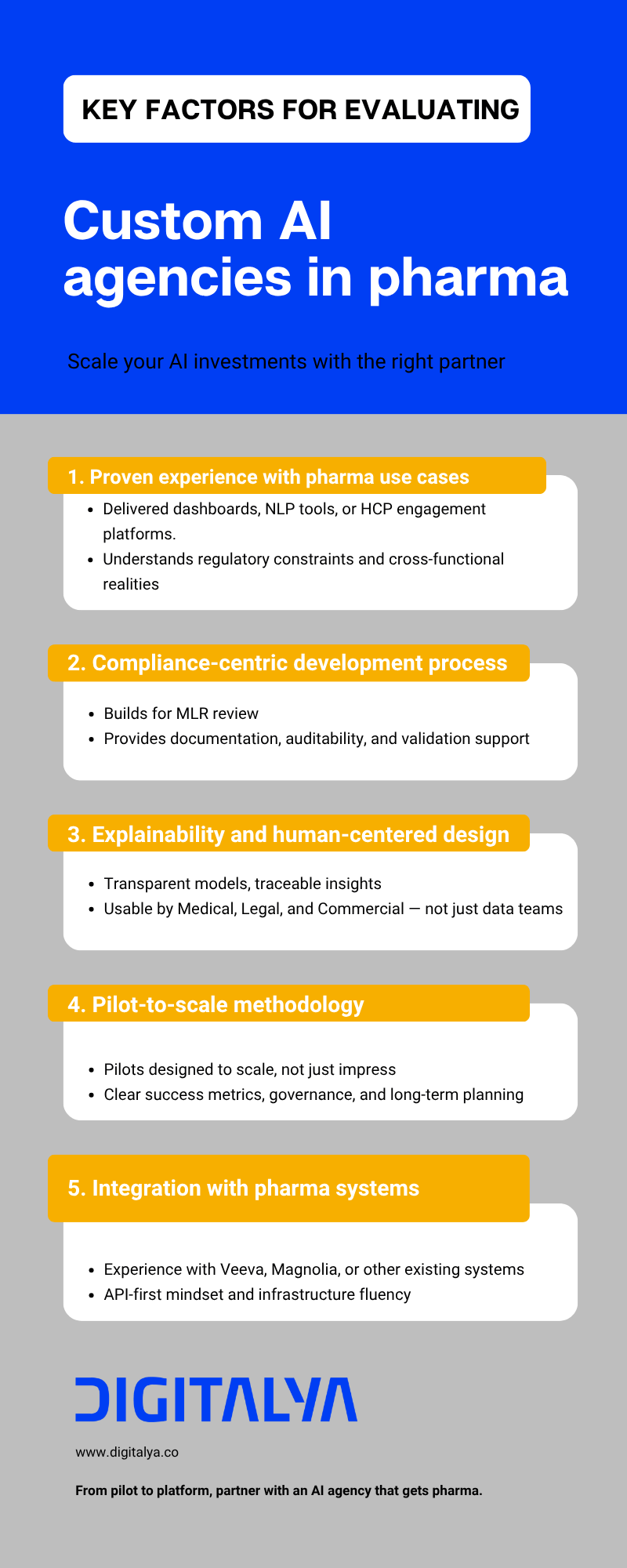
Key factors for evaluating custom AI agencies in pharma
Quick answer:
To assess a custom AI agency for pharma, look for pharma experience and regulatory readiness. Check for explainable AI, smooth integration with existing platforms, and a strong track record. They should be able to turn pilots into scalable, compliant solutions.
Factor #1 — Proven experience with pharma use cases
AI in the pharmaceutical industry is about solving the right problems within complex, regulated environments. That’s why your selected AI partner must bring domain-specific experience, not just technical capability.
Look for a track record that aligns with your unique needs, such as:
- Building custom analytics dashboards for medical affairs or commercial teams.
- Developing NLP-driven tools that analyze data from unstructured content like research papers or internal reports.
- Supporting healthcare professional engagement through intelligent portals or personalization engines.
- Designing pilots with a clear path to scale — not just POCs, but proofs of value.
- Enhancing digital touchpoints with HCPs through intelligent AI powered personalization and content delivery platforms.
- Using machine learning to surface engagement patterns and optimize content timing for healthcare providers.
Questions to have in mind:
- Have they delivered platform-based solutions for pharma workflows — not just models, but usable, compliant interfaces?
- Do they understand cross-functional alignment across digital, medical, and commercial?
- Can they adapt their technology to your infrastructure, regional needs, and compliance expectations?
The best AI agencies don’t lead with technology alone, but with a combination of tech and pharma literacy. It’s now about how well they understand agentic AI. If they can’t speak your language or anticipate regulatory realities, they may build something impressive that nobody can use.
Factor #2 — Industry regulations and data security
AI systems used in pharma must support compliance requirements, such as:
- auditable data pipelines
- documented workflows
- data privacy and governance practices
Agencies should know frameworks like GDPR and HIPAA. And they should build AI systems that support traceability and internal review.
What to look for:
- Knowledge about data governance, including strong data management practices and a focus on data privacy.
- Audit trails and documentation that meet MLR or QA team requirements.
- A development process that accommodates cross-functional review cycles.
- Experience handling structured and unstructured data in controlled environments.
- Architecture that supports user permissions, version control, and traceability.
- Implementation of data security measures aligned with cybersecurity frameworks.
- Demonstrated understanding of data privacy obligations under GDPR and HIPAA, with processes to manage content, anonymization, and regional data restrictions.
A compliant AI powered solution must be both usable and safe.
That’s why the agency must support validation, documentation, and internal review. Otherwise, you’ll end up with a black-box tool that no stakeholder can trust or approve.
For pharmaceutical companies, proving how an AI system works is as crucial as making it work.
For example, when implementing generative AI, explainability is especially critical — outputs must be traceable, editable, and reviewable by internal stakeholders.
Factor #3 — Explainability and human-centered design for AI solutions
AI outputs must be interpretable by stakeholders, including:
- medical teams
- legal and regulatory reviewers
- commercial decision-makers
Explainability is the bridge between AI and human decisions. In pharma, that bridge must support the weight of regulatory reviews, internal skepticism, and brand risk.
Explainable systems increase trust, support regulatory review, and improve adoption across teams. Plus, they have a better chance to ultimately improve patient care.
When evaluating an AI agency, look beyond the algorithms. Ask how they design interfaces, dashboards, and outputs to promote clarity, transparency, and confidence.
People won’t use a beautifully built platform if they misunderstand or mistrust it. A good agency knows that building a model is only half the job; the other half is building user trust.
What to look for:
- Can users trace outputs back to interpretable inputs or model logic?
- Are natural language processing results shown with confidence levels, filters, or data lineage?
- Is there a design system in place to highlight model decisions without overwhelming users?
- Do dashboards empower business decisions, or do they require data science translation every time?
Explainable AI enhances the effectiveness of decision-making in pharma by ensuring that outputs are both readable and actionable. If the agency can’t build AI solutions that communicate clearly, they’re not building AI for pharma.
Factor #4 — Pilot-to-scale methodology
Most pharma AI solutions initiatives start as pilots, and most of them stay there. This might happen, among other factors, because the selected AI agency didn’t plan beyond the proof of concept.
The goal of a pilot extends beyond testing to determine if AI technologies are effective in practice.
The main purpose is to confirm it works in your context. It should fit your data, systems, stakeholders, and regulatory constraints.
Successful pilots should improve workflow efficiency and reduce costs by automating repetitive tasks. They should minimize manual work and integrate smoothly into existing business processes.
A strong agency will plan the pilot for scaling from day one. It will treat it as the first step in a larger deployment, not a standalone showcase.
What to look for:
- Measurable outcomes: what KPIs or business outcomes will validate the pilot?
- Clear thinking around data quality, availability, and handover to internal teams.
- A roadmap for turning a pilot into a platform: scalable architecture, retraining process, governance.
- Model governance processes for maintaining machine learning models post-deployment, including monitoring, drift detection, and version control.
- Realistic conversations about change management and user onboarding.
For pharmaceutical companies, innovation only matters if it’s sustainable. The right AI agency should be a growth partner. It should help you go beyond innovation “theater.” It should guide you toward AI adoption across your entire company.
Ask every agency pitching a pilot: What happens after it works?
Factor #5 — Integration with existing systems
AI tools must integrate with existing enterprise platforms.
This includes support for your:
- CRM systems
- internal data infrastructure
- content workflows and approval systems
Disconnected AI tools rarely deliver long-term value.
A seamless integration with your current tech stack determines whether the AI tool outputs:
- Flow directly into field force tools, or data remains siloed.
- Support healthcare professionals’ segmentation and personalization.
- Get reviewed, approved, and distributed without creating bottlenecks.
What to look for:
- Proven experience working within pharma’s modular and global system architecture.
- API-first mindset with secure, documented integrations.
- Understanding of data permissions, roles, and access control.
- Ability to work with cross-functional stakeholders, not just IT or data science teams.
Disconnected AI-powered tools can be hazardous. If actionable insights can’t flow through the systems that power decision-making, then you have a dead end. The right AI partner understands that integration has an impact.
Additional signals of a strong AI partner
Beyond technical capabilities, several additional signals can help identify a strong AI development partner.
Portfolio strength
A company’s portfolio demonstrates the types of problems they have solved and the industries they understand.
Reviewing previous projects can reveal whether the agency has experience delivering solutions similar to your needs.
Client feedback and reviews
Testimonials and public reviews provide insight into how previous clients experienced the collaboration.
These perspectives can help evaluate:
- communication quality
- project management effectiveness
- long-term reliability
Professionalism during the discovery phase
Early conversations with a potential partner can reveal a lot about how they operate.
Strong agencies are transparent about:
- their capabilities
- project scope and risks
- realistic timelines and expectations
They may also challenge assumptions to ensure the best outcome for the project.
Red flags to avoid when choosing a custom AI agency
As a leader assessing potential partners, spotting these red flags early can save your team months of wasted effort. It can also prevent stalled pilots or compliance fixes.
Failure to address these risks can directly impact patient safety by increasing the likelihood of:
- errors
- non-compliance
- and regulatory breaches.
It can also undermine patient adherence by delivering unstable or ineffective AI-driven support.
Here’s what to watch for:
- No pharma, healthcare, or life sciences experience: They might be learning on your budget. This could potentially result in missing unseen regulatory and stakeholder requirements.
- No plan for documentation, validation, or audit readiness: The agency should show how its solutions comply with GxP or MLR requirements.
- Overpromising “plug-and-play” solutions: Custom AI solutions for pharma companies aren’t plug-and-play. They require collaboration, data context, and phased deployment. Too good to be true timelines can show a lack of real-world experience.
- One-off dashboards with no scaling path: A beautiful demo means little if there is no clear path to rollout, onboarding, or ongoing support and maintenance. Ask: What happens in month 7?
- Minimal understanding of your existing stack: They should understand Veeva, Magnolia, Salesforce, and your internal architecture.
Additional risks include:
- choosing a partner based solely on cost rather than long-term value
- overlooking the importance of strong communication and collaboration
- failing to consider future maintenance and platform evolution
An agency that builds fast but can’t validate, scale, or support is more risk than value. Yes, you need innovation, but you should also look for a pharma-literate approach to execution.
How Digitalya supports AI development in pharma
Organizations implementing AI solutions in healthcare and pharmaceutical environments often require partners who understand both technology and regulatory complexity.
Digitalya supports organizations building digital health platforms and data-driven healthcare solutions by combining software development expertise with domain understanding of healthcare workflows.
Services include:
- pharma web and portal development
- medical application development
- custom data-driven platforms
- AI-enabled digital health solutions
By combining domain knowledge with modern development practices, organizations can create scalable platforms that support innovation while maintaining regulatory and workflow requirements.
Key takeaways
- Choosing the right custom AI agency for pharma requires evaluating both technical expertise and domain knowledge.
- Agencies must understand regulatory frameworks and build explainable AI systems that stakeholders can trust.
- Successful AI initiatives move beyond pilots and scale into production platforms integrated with enterprise systems.
- Strong partners combine AI capabilities with pharma-specific experience and structured development processes.
- Collaboration quality, portfolio strength, and long-term support capabilities are critical evaluation criteria.
Final thoughts
Selecting a custom AI agency involves choosing a partner who understands the pharmaceutical industry. One who can easily get familiar with your specific constraints and unique goals.
Here are some of the things that the right agency should bring to the table:
- Pharma-literate thinking, not just technical talent.
- A compliance-first approach that doesn’t slow innovation, it enables it.
- A clear plan to scale from pilot to platform, without burning out budgets or stakeholders.
- Solutions that fit within your ecosystem and serve the needs of internal teams and the healthcare providers they engage.
As you evaluate potential partners, ask the tough questions. Push past the demos and look for fluency in pharma, not just fluency in Python.
Frequently asked questions
Pharma companies should prioritize agencies with domain-specific experience. They should have a compliance-first mindset, predictive analytics capabilities, and explainable AI capabilities. At the same time, they should be able to integrate with enterprise platforms or internal data lakes.
Explainable AI helps stakeholders across medical, legal, and regulatory teams understand how AI generates its outputs. This transparency supports regulatory review and improves trust in AI-driven decisions.
Red flags include no pharma case studies, no audit-ready plan, vague compliance answers, and timelines that seem too ambitious. Other red flags are one-off pilots with no clear path to scale.
Some general AI agencies may have strong technical skills. But successful pharma projects need knowledge of regulatory rules and industry workflows. That’s where a pharma AI agency can help.
Ask about the agency’s experience with the tools you’re currently using. Choose partners with secure, well-documented APIs and proven deployment in modular enterprise ecosystems.
Common risks include agencies without pharma experience, a lack of compliance readiness, unclear scaling strategies, and tools that cannot integrate with existing systems.