To provide real value, pharma needs an AI strategy. It should match business goals and follow strict rules. It should also focus on cases that boost efficiency, quality, and engagement.
1. Pharma’s AI moment requires strategy, not hype
AI has rapidly moved from an experimental curiosity to a core capability shaping how pharma communicates, operates, and delivers scientific value. Every team, from medical affairs to commercial and R&D to operations, feels pressure to “do something with AI.”
Teams test tools, developers multiply proofs of concept, and vendors promise transformative impact.
Yet, despite this momentum, many organizations aren’t seeing meaningful results. The reason is simple: most AI initiatives begin with hype, not strategy.
Instead of focusing AI investment on real business problems, teams often start by exploring tools. They may launch pilots or react to internal excitement. The outcome is predictable — excitement without direction, adoption without alignment, and innovation without measurable value.
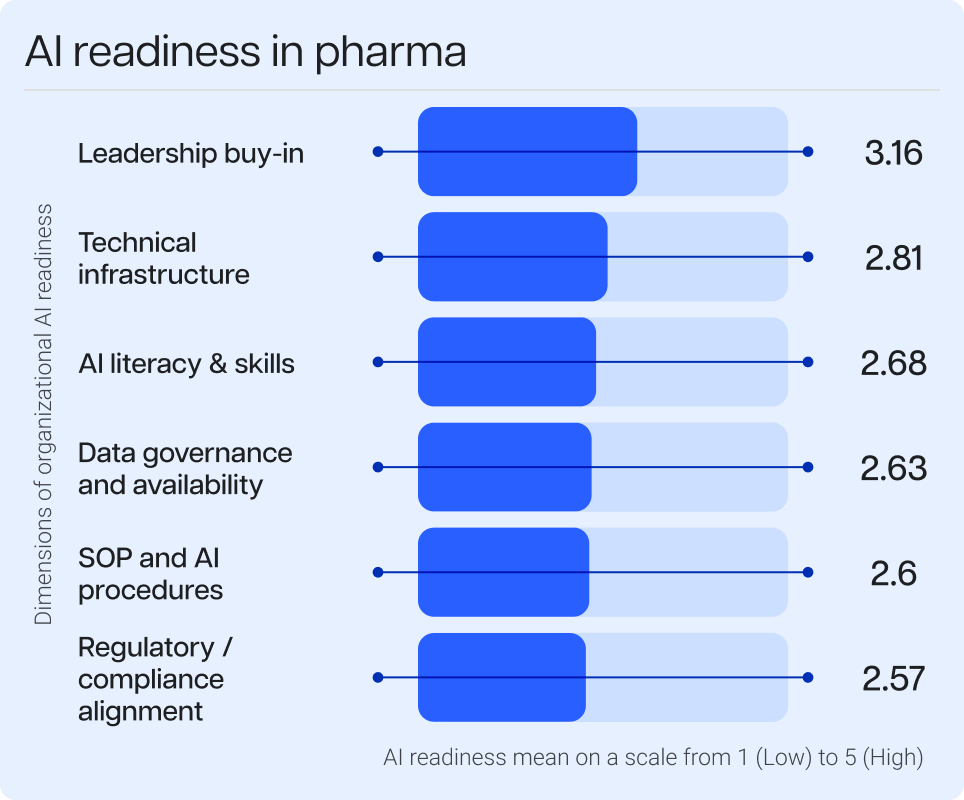
Leadership buy-in is the most developed factor in organizational AI readiness, according to our state of AI in pharma report. However, other important areas are not as developed.
These areas include Regulatory and Compliance Alignment, Standard Operating Procedures (SOPs) and AI Procedures, Data Governance and Availability, and AI literacy and skills. All of these are at the bottom of the AI readiness scale.
Pharma’s moment is not about adopting more AI. It’s about choosing where AI actually matters.
To provide value, an AI strategy must set clear priorities. It should also address data and governance issues. Finally, it needs to create ways for compliant and scalable implementation.
Without this foundation, even the most advanced models become isolated experiments — impressive in demos, but disconnected from daily workflows and organizational goals.
The pharmaceutical industry needs a strategic approach that turns AI from scattered activity into sustained, enterprise-level impact.
2. What “value” means in pharma AI
Value from AI isn’t about novelty, automation for its own sake, or how advanced a model appears. We measure value by how effectively AI supports scientific accuracy, compliance, operational efficiency, and meaningful engagement with healthcare professionals.
Unlike other industries, where people often celebrate experimentation, pharma’s high-stakes environment demands outcomes that are reliable, traceable, and directly tied to organizational goals.
Real value emerges when AI addresses specific pressure points across teams:
Operational value
Reduce manual work, speed up content creation and review, improve consistency, and let experts focus on essential tasks. When medical writers, MLR reviewers, and commercial teams save hours, AI becomes a genuine accelerator.
Medical and scientific value
Enhancing the clarity, accuracy, and consistency of scientific communication. AI should help find insights faster. It should also summarize the literature better. Finally, it must keep medical content aligned with evidence and internal guidelines.
Commercial and engagement value
Improving HCP engagement through better personalization, more relevant content, and faster response times. Value is not the AI output itself, but the impact on understanding and serving healthcare professionals more effectively.
Organizational value
Enabling teams to work with shared knowledge, better governance, and more predictable workflows. AI becomes a valuable asset when it makes medical, legal, and commercial functions easier. It should not add more complexity.
AI can become a strategic capability that improves how pharmaceutical companies communicate, operate, and deliver scientific impact.
3. The pillars of an AI strategy that works in pharma
Designing an AI strategy that delivers value needs a structured approach that aligns AI with business priorities, operational realities, and regulatory expectations.
A. Business alignment: start with problems, not tools
Too many projects begin with the question “What can AI do for us?” instead of “Where are we losing time, consistency, or insight today?“
As James Turnbull said in our webinar Is Pharma Ready for AI at Scale?:
James Turnbull, CEO of medcomms agency Camino CommunicationsCompanies need to move towards a bottom-up approach in which leaders work with the team to identify AI use cases that actually make sense and deliver value.
A value-driven AI strategy begins by identifying high-friction areas across medical, commercial, and operational teams. These workflows are often repetitive, manual, slow, or rely on expert knowledge. Compliance and governance rules also limit them.
Once these challenges are mapped, AI use cases should be prioritized based on three criteria:
- Business impact — will this materially improve efficiency, quality, or engagement?
- Feasibility — is the data available and sufficiently structured?
- Compliance fit — can this be implemented within regulatory constraints?
When organizations connect AI to business results, they find it easier to get support from leaders. They can also align stakeholders and set clear success metrics.
B. Data readiness: the foundation of all AI
AI strategies rise and fall on the quality of the data beneath them. In life sciences, data is abundant, but rarely unified. Scientific publications, internal guidance, CRM records, regulatory documentation, and medical content often live in disconnected systems.
A mature AI strategy treats data as a strategic asset. This means investing in:
- Structured and well-governed data sources
- Clear taxonomies and metadata
- Access controls and versioning
- Data quality standards aligned with medical and regulatory requirements
Without this foundation, AI outputs become inconsistent, unreliable, or difficult to validate. With it, AI can surface insights faster, generate content with greater confidence, and support traceability.
C. Technology architecture: choose tools that scale
Choosing the right AI architecture is about designing systems that can grow with the organization. In pharmaceutical companies, AI should fit well with current digital systems. This includes CRM platforms, document management, and MLR workflows.
A scalable architecture typically includes:
- Large AI models or smaller domain-specific models
- Retrieval-augmented generation to ground outputs in trusted sources
- Secure APIs and modular components
- Integration layers connecting AI capabilities to everyday tools
This approach prevents AI from becoming a collection of disconnected tools. Instead, it enables pharma teams to reuse components, expand capabilities, and maintain consistency across use cases.
D. Responsible & compliant AI: pharma’s non-negotiable framework
Compliance is often seen as a constraint on innovation. In reality, it’s what makes sustainable AI adoption possible. An effective AI strategy embeds responsibility and governance from the start, and not as an afterthought.
This includes:
- Clear AI governance frameworks aligned with MLR processes
- Defined rules for content generation and review
- Audit trails, version control, and explainability
- Human-in-the-loop validation for all high-impact outputs
Rob Verheul, CEO of design agency Graphite DigitalCompliance and creativity don’t need to pull in opposite directions. AI can take friction out of the process, spotting risks early, streamlining approvals and supporting smarter content reuse. Combined with a robust design system, it can also bring consistency and scalability, giving teams the freedom to create at speed while staying within brand and regulatory guardrails. In this way, compliance stops being the brake pedal and becomes the framework that lets innovation move faster, with trust built in.
Responsible AI builds trust. When medical, legal, and commercial stakeholders trust the system, adoption accelerates and innovation becomes repeatable rather than risky.
E. People, change & process: strategy is not only technical
Even the best-designed AI strategy will fail without human adoption. AI changes how people do their work, and that requires clear communication, training, and process design.
Successful pharma companies focus on:
- Clearly defining where AI assists and where human judgment remains essential
- Training teams to use AI confidently and responsibly
- Embedding AI into existing workflows rather than forcing new ones
- Establishing feedback loops to regularly improve outputs
AI should reduce friction, not create it. When teams feel supported instead of replaced, they accept AI as a helpful part of their work. This leads to lasting impact through strategy.
4. High-value use cases pharma should prioritize first
High-value use cases share three characteristics:
- They address real operational friction
- They fit within existing compliance frameworks
- They deliver measurable impact in a relatively short time frame
Pharma companies should focus on using AI to quickly improve consistency, support teams, and reduce workload.
A. Medical affairs & scientific content
Medical and scientific teams are often the most constrained by time, volume, and complexity. AI can deliver significant value here by acting as an augmentation layer, not a replacement for scientific expertise.
High-impact uses include:
- Literature and evidence briefs — helping teams synthesize vast amounts of scientific content faster
- Congress insights automation — extracting key themes, questions, and trends from events
- MLR pre-checks — identifying potential compliance issues before formal review
Manuel Mitola, former pharma leader and currently AI strategist at ctcHealth, sees a significant trend towards AI in medical departments:
The value lies in accelerating workflows and improving consistency, while keeping scientific accuracy and oversight firmly in human hands.
B. Commercial & HCP engagement
Commercial teams face increasing pressure to deliver relevant, personalized experiences to healthcare professionals across more channels with fewer resources.
Priority use cases include:
- Personalized content generation — tailored to HCP’s speciality, interests, and engagement history
- Message optimization — ensuring consistency across channels and regions
- Predictive insights — helping teams anticipate HCP needs and engagement patterns
- Multichannel orchestration support — aligning messaging across email, CRM, and digital touchpoints
- AI-powered chatbots — provide support and information in real time
Here, value is measured by improved relevance, engagement quality, and strategic focus.
C. Internal operations
Some of the fastest AI wins in pharma come from internal operations. We often overlook these areas in favor of more visible external use cases.
High-value applications include:
- Enterprise knowledge retrieval — enabling teams to quickly find validated internal documents, guidance, and SOPs
- Workflow automation — reducing repetitive administrative tasks
- Document classification and tagging — improving accessibility and governance
- Internal Q&A assistants — supporting onboarding and cross-functional collaboration
These use cases may not seem exciting, but they provide strong returns. They save time, reduce problems, and improve teamwork.
James Turnbull shared a few projects he worked on that provide real value:
AI has the most significant impact in pharma when it starts by solving real problems.
Conclusion
AI has reached a turning point. The question is not if organizations should invest in AI. It is about how they can create a plan that provides real, measurable value.
Pharma companies that see AI as just a set of tools will keep facing problems. They will have scattered projects and little impact.
Those who see AI as a key tool will benefit greatly. When AI aligns with business goals, it can be part of daily tasks. This responsible use of AI will boost efficiency, enhance scientific communication, and improve connections with healthcare professionals.
Designing an AI strategy that delivers value is not about moving faster than everyone else. It’s about moving deliberately, with purpose and structure. The leaders who get this right today will be the ones shaping how pharma operates, communicates, and innovates tomorrow.