HCP engagement in pharma: how to drive adoption and return visits
AuthorAndrei Ungurianu
CategoryPharma Innovation
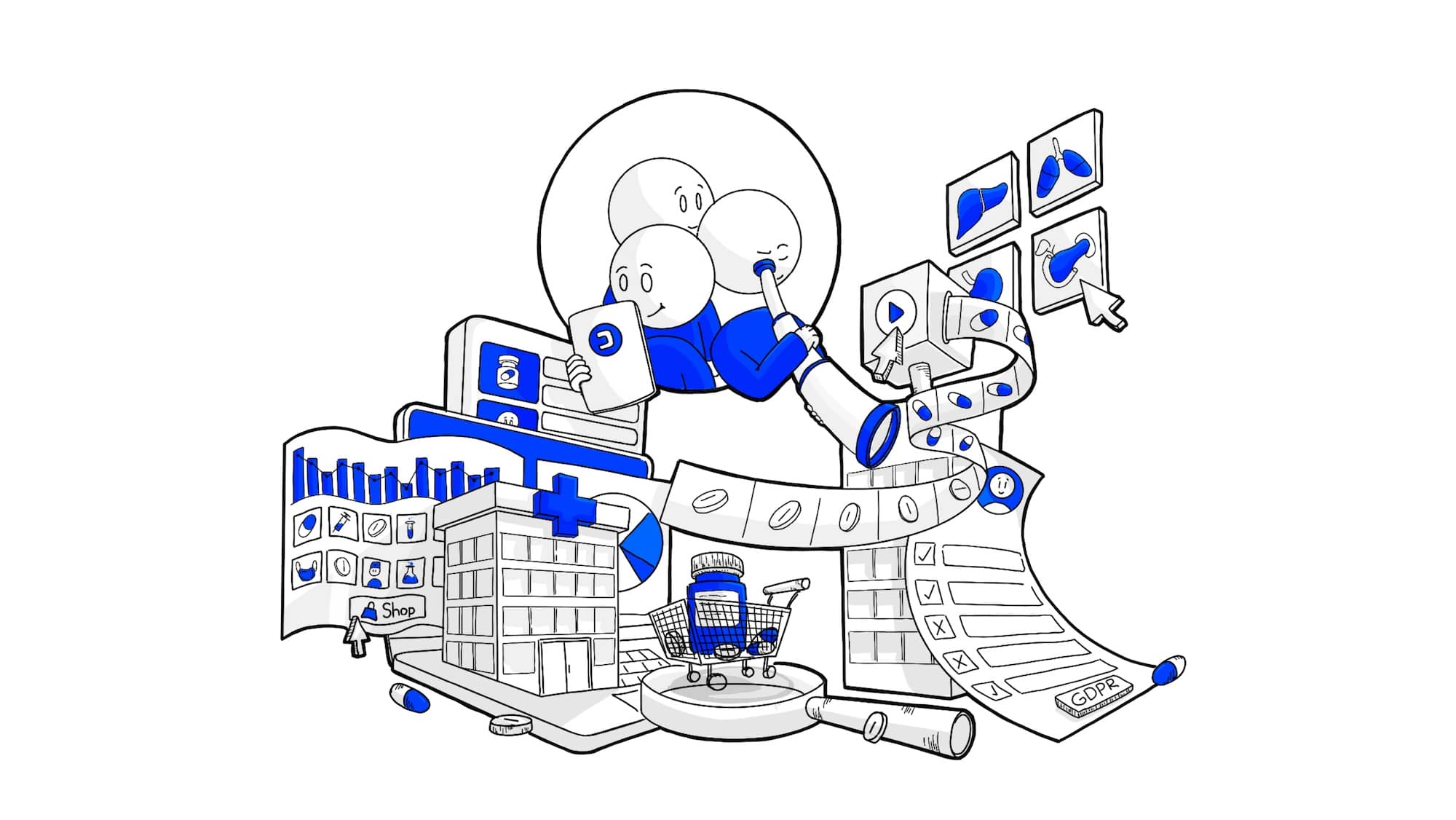
HCP engagement is often treated like a traffic problem: more visits, more clicks, more content. But real engagement is an outcome, not a vanity metric. It’s what happens when healthcare professionals can quickly complete meaningful tasks, trust what they find, and choose to return.
That’s why cross-industry lessons matter. In e-commerce, SaaS, and streaming, companies win by reducing friction, improving discovery, and building habits around ongoing value.
Pharma can borrow these patterns, even with compliance constraints, if we translate them correctly.
Executive summary
HCP engagement grows when portals help HCPs:
Access what they need with minimal friction
Activate quickly (first useful action happens fast)
Get value that supports real clinical work
Return by habit because the portal reliably saves time and improves decisions
This article breaks HCP engagement into a simple ladder:
Access → Activation (first useful action) → Value → Habit
and maps proven cross-industry patterns to each stage, so that pharma teams can improve adoption and return visits.
What is HCP engagement in pharma?
HCP digital engagement is the ability of a pharma brand’s ecosystem, especially its HCP portal, to help healthcare professionals complete meaningful tasks (learn, decide, download, request, follow up) and choose to return over time.
Engages HCPs beyond just “consume content.” They:
Find trusted information fast (and can verify it)
Discover relevant updates without digging
Use tools or resources that reduce effort in their workflow
Build confidence that the portal is worth coming back to
Engagement is not pageviews, time on site, or “more content.” These metrics can rise even if HCPs feel frustrated or unsupported.
HCP engagement vs. HCP digital experiences
HCP engagement | HCP digital experience |
Is the outcome over time (activation, repeat usage, task completion, trust-driven return behavior) | Is the quality of the interaction (UX, speed, clarity, relevance, navigation, content currency) |
A portal can have a nice experience and still fail to drive engagement if it doesn’t deliver ongoing value, support real tasks, or reduce workflow friction.
If you want to go deeper on the “quality of interaction” side, here’s a breakdown of what makes a strong HCP digital experience.
Key takeaways
Engagement starts (or dies) at access: registration and login friction can prevent engagement before it begins.
Activation depends on speed-to-value. The first useful action must happen quickly.
Value requires trust and relevance. Content must be current, structured, and easy to verify.
Habit is built through discovery: recommendations, smart search, and “next best content” patterns matter.
Cross-industry patterns work in pharma only when translated into compliant, portal-specific workflows.
Andrew Binns, Head of Digital and Innovation at AstraZeneca UK, interestingly said in the webinar Why HCPs Aren’t Engaging with your Portal — Can AI help?:
What we really want is to give each doctor an individual, unique, helpful, resonant experience, and the more refined we get at that, the better the experience will be. That’s where the power of HCP portals is. But it’s a challenge, it’s tough. We’ve got so many issues within this sector that other sectors don’t have; things like compliance, the sign-off process, which makes it incredibly difficult to create these individualized experiences if the MLR review process means they’ve got to see the content in situ. (...) That’s the world we live in, and it’s brilliant and completely fantastic that we live in this very compliant world because we’ve got to be protective over everything that goes out into the world.
– Andrew Binns, Head of Digital and Innovation at AstraZeneca UK
Before diving deeper, it’s important to have the same understanding of HCP preferences and behaviors.
Stage 1: Access — engagement starts before the first click
Effective HCP engagement can’t happen if healthcare professionals can’t get in quickly, find what they need, and trust they’re in the right place. Access is more than just having a portal. It’s the experience of entry and orientation.
HCPs are time-constrained and highly goal-driven.
They prefer digital channels for medical information, with 52% of physicians considering websites essential and favoring them as a source.
That means every step before value—unclear navigation, slow performance, confusing content structure, lengthy registration—reduces the likelihood of engagement.
What “Access” includes in pharma HCP engagement
Access is the combination of four things:
Entry friction — registration, verification, login, password resets
Orientation — can an HCP immediately understand what the portal offers and where to go?
Findability — search + navigation that surfaces the right content fast
Trust signals — medical ownership, content relevance, references, and clarity around the intended audience.
Segmenting access — not every HCP enters the same way
To build trust and engagement, access has to reflect real audience differences:
Primary care vs. specialists — different depth, different urgency, different content paths
Region and tech ecosystem — local compliance, local platform constraints, existing workflows
Digital maturity — some HCPs want fast self-serve; others still rely on human touchpoints
This is why one-size-fits-all portals often underperform. They force all users down the same path, with the same navigation and content structure.
Segmenting access is the first step toward building personalized HCP journeys that actually drive trust and repeat use.
Why portals still matter for HCP digital engagement strategies
HCP portals are still the best place for measurable HCP engagement (adoption + return visits). They combine trusted content, tools, and data-driven discovery in one controlled environment.
When portals work, they are more than content repositories. They:
Support field medical and omnichannel programs with consistent, trackable touchpoints
Make it easier to understand what different HCP segments actually need (behavior + intent signals)
Create the foundation for the compliant personalization later (without guessing)
But here’s the catch: portals only become engagement engines if the access layer is frictionless. Otherwise, they become content repositories behind a login, and engagement stalls before it begins.
Portals are a great way to collect data, making it easier to adapt strategies to engage HCPs.
At the core of digital HCP engagement, pharma portals must be intuitive, user-friendly, and integrate with other digital channels to provide a cohesive, comprehensive experience.
Unfortunately, our recent audit of 28+ European and US portals revealed that many pharmaceutical brands lack in offering user-friendly experiences.
Once access is resolved, the next question is activation: does the HCP complete a first useful action quickly, or do they leave before value is shown?
Stage 2: Activation — get the first useful action to happen fast
Access gets an HCP into the portal. Activation is what happens next: do they complete a first meaningful action quickly, or do they get stuck and leave?
SaaS companies excel in user onboarding by minimizing friction. An effective onboarding process can boost customer retention by 50%, whereas poor onboarding can lead to a 40-60% dropout rate.
In pharma, the activation moment is often blocked by the same friction point: onboarding that asks for too much, too early.
The activation problem in pharma portals
Many pharma portals still rely on lengthy registration forms, sometimes with more than 15 fields. And that’s before an HCP can do anything useful.
That’s a high drop-off trigger, especially when the value proposition isn’t immediately visible.&w=1080&q=75)
Example of a lengthy registration form used on a pharma portal
These friction points repeatedly appear in portal benchmarks — here are the hidden reasons behind low HCP portal adoption (and what AI can realistically improve).
As Rob Verheul, CEO of UI/UX agency Graphite Digital, puts it:
The drop-off in registrations and logins is enormous, so we need to give value to people and reasons to log in.
– Rob Verheul, CEO, Graphite Digital
Cross-industry pattern: progressive onboarding
SaaS onboarding doesn’t treat the registration form as a compliance ritual. It’s a conversion step that must be earned. The idea is simple:
Collect only relevant information upfront — eliminate non-essential fields in the first step. Move “nice-to-have” data to a later stage.
Offer gradual profile building (progressive profiling) — let HCPs enrich their profile over time rather than during the first session.
Make the form feel shorter — use progress indicators, checklists, and clear “why we’re asking this” microcopy to reduce perceived effort.
Use interactive, low-friction UI patterns — tools like Officevibe use interactive form patterns that make completion feel quick and guided, not like paperwork. Portals can use the same design logic, icons, smarter field types, and friendlier interactions to increase completion rates.
&w=2048&q=75)
Activation KPIs (what to measure)
If this is truly about HCP engagement, track activation like a product team would:
Registration completion rate
Login success rate (including password reset success)
Time to first useful action (e.g., first resource view/ download/event registration)
First-session task completion rate (by segment)
Once activation is solved, engagement becomes a content and discovery problem: do HCPs consistently find what they need fast, and does the portal feel worth returning to?
Stage 3: Value — make the portal worth returning to
After access and activation, HCP engagement becomes a value question: does the portal reliably save time, reduce uncertainty, or support clinical work?
If the answer is sometimes, return visits stop. If the answer is sometimes, engagement becomes a habit.
Cross-industry leaders build value through one core capability: fast discovery of the most relevant next thing, without making users search like librarians.
&w=1920&q=75)
The value problem in many HCP portals
Even when the content is high quality, portals often fail on delivery:
Content is hard to find (weak search, unclear taxonomy, too many clicks)
Content feels generic (no relevance cues for role, specialty, interest)
The portal behaves like a repository, not a service layer
In practice, that means HCPs bounce back to external sources, not because they don’t trust pharma, but because the path to value is shorter elsewhere.
Cross-industry pattern: recommendations that reduce effort
Amazon doesn’t rely on users to navigate categories perfectly. It reduces choice overload by continuously answering: “What should you look at next?”
Pharma portals can apply the same underlying logic by guiding HCPs toward:
The most relevant new data since their last visit
Content linked to their specialty and interests
Next-step resources after a page view (e.g., summary → full data → patient resource → downloadable slide deck)
Practical value tactics for HCP portals
Add “Next best content” modules — place recommendations at the end of key pages (like “Related clinical data,” “Commonly used resources,” “What changed since the last update”)
Build value around tasks, not pages — organize journeys around what HCPs try to do (verify, learn, download, register, request) rather than around internal content types.
Make relevance visible — use short relevance cues: “Updated last month,” “New trial publication,” “For cardiology,” “3-min summary.” This increases trust and speeds decisions.
Improve discovery with smart research — search should handle medical terminology, synonyms, and intent (not just exact keyword matches). If the search fails, engagement fails, because the portal becomes hard work.
An AI-powered search bar can show more suggestions based on what’s searched.
These personalized recommendations can go even further. By using browsing history, interactions, and other data points (such as email interactions), you can offer a personalized recommendation system for your homepage.
Just as each refresh on Amazon.com changes the items based on past interactions, the same can be true for pharma portals—making it easier for people to resume where they left off, dig deeper into related topics, and uncover unseen content that might help them.
Studies confirm that 80% of consumers are more likely to do business with a company that offers a tailored experience. Plus, 90% find personalization very appealing.
This is the foundation of personalized HCP engagement — but it needs the right governance and data boundaries.
&w=3840&q=75)
Cross-industry pattern: conversational discovery (AI chat) for “find the right thing fast”
In many digital products, users don’t engage more because the content is better, but because it’s easier to find the right thing quickly.
Conversational interfaces reduce search and navigation effort by allowing users to describe their intent in plain language.
The SaaS industry has perfected the art of ongoing support and digital engagement through AI-powered chatbots.
For example, Intercom’s Fin handles up to 87% of customer queries independently, with customers noticing double-digit gains in engagement.
Considering that 70% of HCPs say they’re interested in live chat functionalities. Yet, most portals completely lack this feature. Exploring the benefits of AI chatbots can prove to be a great addition to the digital stack.
&w=1920&q=75)
How can this be translated into the pharmaceutical industry?
In HCP portals, the safest and most effective version isn’t “Ask AI anything.” It’s conversational discovery: a guided layer that helps HCPs find approved portal resources faster.
Instant support – AI chatbots can provide valuable insights and real-time answers to drug interaction queries and dosage calculations, and offer access to the latest studies.
Content discoverability – AI chatbots can offer faster access to relevant content by allowing HCPs to search or ask using natural language.
Data-driven personalization – Analyze user behavior to personalize content.
Enhanced marketing results — Use chatbots to trigger timely feedback and share resources, complementing traditional communication methods such as email and field medical team visits.
Other companies already see results.
Sephora’s Kik chatbot increased survey responses by 70% compared to emails. Getting feedback when someone is already interacting with your brand is easier than when you are interrupting their day-to-day.
The biggest fear with custom-made GenAI chatbots is regarding regulations. The solution is to use machine learning and train the AI on your knowledge base to ensure accurate answers.
Moreover, such AI systems can adopt your brand's tone of voice, adhere to policies, and even integrate with platforms like Veeva CRM to update HCP interactions—fueling further personalization and improving engagement with HCPs effectively.
All the generated data can then fuel the recommendation system within your portals, leading to even more customized and unique digital experiences.
If you’re considering this capability, here’s a practical guide to GenAI chatbots for HCP portals.
The State of AI in Pharma: Trends, Benchmarks, and What's Next
Get our exclusive market research, featuring insights from 200+ leaders across the EU, US, and Asia.
&w=3840&q=75)
Stage 4: Habit — create reasons to return without being pushed
If Stage 3 (Value) answers “Is this portal worth it?” then Stage 4 (Habit) answers “Why should I come back next week?”
In other industries, habit is built through repeatable value loops: short-form content that fits busy schedules, clear progression, and lightweight interactivity that keep users moving.
Cross-industry pattern: interactive formats that reward repeat engagement
In streaming and modern digital learning, retention improves when platforms make it easy to start and finish tasks and make it obvious what to do next. The same logic applies to HCP engagement, especially for busy users who don’t have time to explore a portal.
Top platforms increase return behavior by:
Breaking content into short, structured modules (easy to start, easy to finish)
Using interactivity to keep attention (quizzes, checkpoints, “choose what you want next”)
Creating a sense of progression (“continue where you left off,” “new since last time”)
How to translate it for pharmaceutical companies
Habit-building in HCP portals comes from formats and features that fit real HCP workflows:
Micro-learning modules
Turn long resources into short “decision-support” units: summary → key data → references → next action.
“New since your last visit” updates
Give HCPs a reason to return by highlighting what changes: new data, updated resources, new versions.
Series over one-offs
Build repeatable bundles (“Monthly evidence update,” “Case discussion series,” etc) so returning feels purposeful, not random.
These habit loops are much easier to sustain with dynamic content for HCP portals — content that updates, recombines, and stays current.
No one on planet Earth wakes up in the morning and thinks, ‘I want to go to a pharma website and get a personalized experience.’ And likewise, I don’t go on to Netflix and think, ‘This is an incredible personalized experience for me.’ What I do think is ‘This is brilliant, I’m seeing content that’s relevant and useful to me,’ and that makes me a brand loyalist.
– Andrew Binns, Head of Digital and Innovation at AstraZeneca UK
How interactive media can improve HCP engagement
Interactive media improves engagement when it does one thing well: reduce effort while increasing clarity and confidence. Instead of asking HCPs to read long pages and assemble meaning themselves, personalized interactive experiences guide them through key information and route them to the underlying sources for verification.
1. Interactive videos
Perfect for educational content and explainers for new treatments — similar to Netflix’s interactive TV shows.
Portals are not doing great in meeting healthcare professionals' demands for learning opportunities. In fact, just 30% of portals offer learning tools, while many HCPs demand them.
&w=1920&q=75) Adding interactive videos to the mix can be a great way to increase interactivity, engagement, and repeat visits.
Adding interactive videos to the mix can be a great way to increase interactivity, engagement, and repeat visits.
Interactive videos can be used for non-accredited learning, webinars, or for transforming lengthy PDFs into easily digestible videos with chapters and quizzes.
2. Dosing and safety quizzes
These interactive tools are great for adapting classic documents and brochures into digital formats that better meet the needs of HPCs (especially when they are low on time).
A good example is PfizerForAll’s migraine screener helps users determine their treatment eligibility through a simple interactive quiz. A similar approach can be used for HCPs looking to find resources.
&w=2048&q=75)
3. Patient resource generators using digital tools
Allow doctors to customize patient education materials with a few clicks, filtering content based on specific patient characteristics.
&w=2048&q=75) One high-impact area is education — here are examples of interactive content for HCP continuing education that go beyond the webinar.
One high-impact area is education — here are examples of interactive content for HCP continuing education that go beyond the webinar.
The insight here is clear: effective personalization doesn’t need to be overtly requested—it should simply work in the background. Healthcare professionals will appreciate a portal that intuitively adapts to their needs without demanding extra effort.
What powers HCP engagement at scale: data-compliant personalization and omnichannel orchestration
The engagement ladder only becomes repeatable when you can measure behavior, learn from it, and improve the experience across channels. That’s what data enables: better decisions about what to build and what to fix.
Cross-industry pattern: use behavioral data to improve journeys
High-performing digital products treat data as a feedback loop:
They track where users drop off
They identify the actions that correlate with retention
They personalize discovery based on observed intent
How to translate it into pharma HCP engagement
In pharma, data should help you do three practical things:
Diagnose engagement friction
Where do HCPs drop off? Registration, search, content pages, downloads, events?
Segment by intent, not just specialty
Different users come with different goals. Engagement improves when the portal directly supports those tasks.
Power-compliant personalization
Use portal behavior (what they read, what they search, what they download) to improve relevance, while staying within regional rules and consent requirements.
This is where AI behavioral insights can help you move from reporting to predicting what drives adoption and return visits.
What data to collect?
To build an engagement loop, you typically need inputs from:
Portal analytics — navigation paths, search queries, content interactions
CRM signals — consented interaction history, channel preferences
Campaign interactions — email clicks, event attendance, downloads
Market research insights where available
What to measure?
Tie measurement to the ladder:
Access — registration completion, login success, time-to-first page
Activation — time-to-first useful action, first-session task completion
Value — search success rate, time-to-right resource, downloads/saves
Habit — 30/60/90-day return rate, repeat usage of modules/series
Cross-industry pattern: meet users where they are
Even with a strong portal, engagement fails if you only show up in one place. Some HCPs prefer digital; others still need field interactions or print materials. The goal is orchestration, not channel purity.
Portals perform best when they’re orchestrated across channels — here’s a strategic guide to improving the HCP omnichannel journey.
How to translate it into pharma HCP engagement strategies
Use the portal as the trusted source hub
Use other channels to route HCPs back to the hub when useful (email → portal update, rep visit → follow-up resource link, webinar → portal recap pack)
What to measure?
Channel preference signals
Assisted journeys (email/rep/webinar → portal action)
Resource reuse across channels (same asset used multiple ways)
What the future holds for the pharma digital landscape
HCP engagement is moving in the same direction as every other mature digital ecosystem: from content delivery to service design.
HCPs return to portals because they consistently help them to do real work faster, with confidence and trust.
The portals that win treat engagement like a product discipline: reduce friction, accelerate time-to-value, improve discovery, and build repeatable value loops. Then measure and iterate.
If you’re exploring the bigger picture, here’s how AI in HCP engagement is changing pharma’s digital playbook.
The HCP engagement ladder (recap)
Access — can HCPs get in quickly and find their way without friction?
Activation — do they complete a first useful action fast or bounce before value shows up?
Value — do they reliably find relevant, trusted resources that support real clinical tasks?
Habit — do you give them clear reasons to return?
Implementation checklist (recap)
If you want to increase adoption and return visits, start here:
Remove access friction
Shorten the registration process and reduce login failure points
Make the portal’s value proposition obvious in the first screen
Engineer activation
Define “first useful action” and optimize for it
Use progressive profiling instead of front-loading forms
Make discovery effortless
Fix search and taxonomy so HCPs can find resources fast
Add “next best content” and “new since last visit” modules
Build repeatable value loops
Use micro-learning and interactive media
Turn one-off resources into series and update packs
Close the loop with data
Measure engagement by stage
Use behavioral signals to improve relevance and compliant personalization over time
Cross-industry lessons are useful, but the advantage comes from translation, not imitation. The goal isn’t to make pharma portals feel like Amazon or Netflix.
The goal is to borrow experience patterns that reduce effort and increase returns, then apply them in a compliant way to the realities of HCP work.
&w=3840&q=75)
Andrei Ungurianu
Head of Marketing @Digitalya
Browse more related content
&w=3840&q=75)
Internal AI chatbots for pharma — streamlining internal processes
Internal processes often involve intricate data management, regulatory compliance, and cross-departmental communication, particularly within commercial, medical, and cross-departmental communication. AI chatbots for pharma have emerged as powerful tools to address these challenges, offering streamlined operations and enhanced productivity.
&w=3840&q=75)
Common UX issues in pharma portals (and how to fix them)
Pharma portals have evolved fast over the last few years. What began as simple content repositories for healthcare professionals has changed into complex digital platforms. These platforms support education, engagement, data collection, and omnichannel strategies.
&w=3840&q=75)
The HCP Portal Development Process - Guide for Pharma
A complete guide to HCP portal development for pharma teams, covering requirements, prototypes, security, integrations, testing, and maintenance.