Do you follow your favorite brands on social media? I bet you follow at least five. I probably follow at least fifty.
And why do we do that? Well, personally, I’m a marketer, and I’m curious about how other people market their business. But also because I want to know what they’re up to. What’s new? Who are the people behind those companies? To know when they have awesome offers I could take advantage of. There are tons of reasons why people follow brands.
So you can assume, or better yet, know, that your clients want to follow you on social media. So… why not be there for them?
This is the most straightforward reason why you should do social media marketing. Because your clients want you to. But SMM (social media marketing) is also a ton of work. So let’s see some other reasons why it’s worth it to have a social media strategy.
1. Why is social media marketing important for startups?
Social media is the first channel on which you can connect with your target audience. Probably most of them already use social media, and it you provide helpful content, they will start following you. It is a marketing channel that can help you grow your business and start a healthy relationship with your consumer. Further on, you can move that relationship to your website, but until then, let’s see why social media marketing is important for startups.
- Raises brand awareness – Brand awareness is a vital thing for brands, especially when they’re just starting out. If you have a startup, you should take advantage because social media is known to be the perfect medium to gain that awareness. If you’re in the beginning you can think about investing in influencer marketing, growth hacking, and paid advertising to start growing your audience.
- Helps show your brand’s authenticity – You get to show your clients that you’re not just a company that wants to take their money but a team of people with a vision and a desire to help them achieve their goals. Make sure that you show some vulnerability so you encourage your users to share their stories too. Further on, you can play with user-generated content and create awesome marketing campaigns.
- Gathering data – Social media is the perfect place to have a conversation with your clients. This will help you better understand what their life is like, why they need your product or service, and what you can do to improve their experience with your brand. An effective social media strategy will offer you all the data you need.
- Reputation management – Whether companies are there to hear it or not, people share their experiences with brands on social media every single day. And if you receive negative feedback, that can affect your brand’s image. If you’re there to respond and offer a solution, then that actually improves your reputation, turning you into a thoughtful brand that cares about customer satisfaction. Make sure you listen to your target audience and hear their voice.
Now that you know why it’s so important to be present on social media, let’s get into how you can create a social media strategy for a startup.
Today we’re sharing with you a social media canvas that you can fill in as you’re following this article.
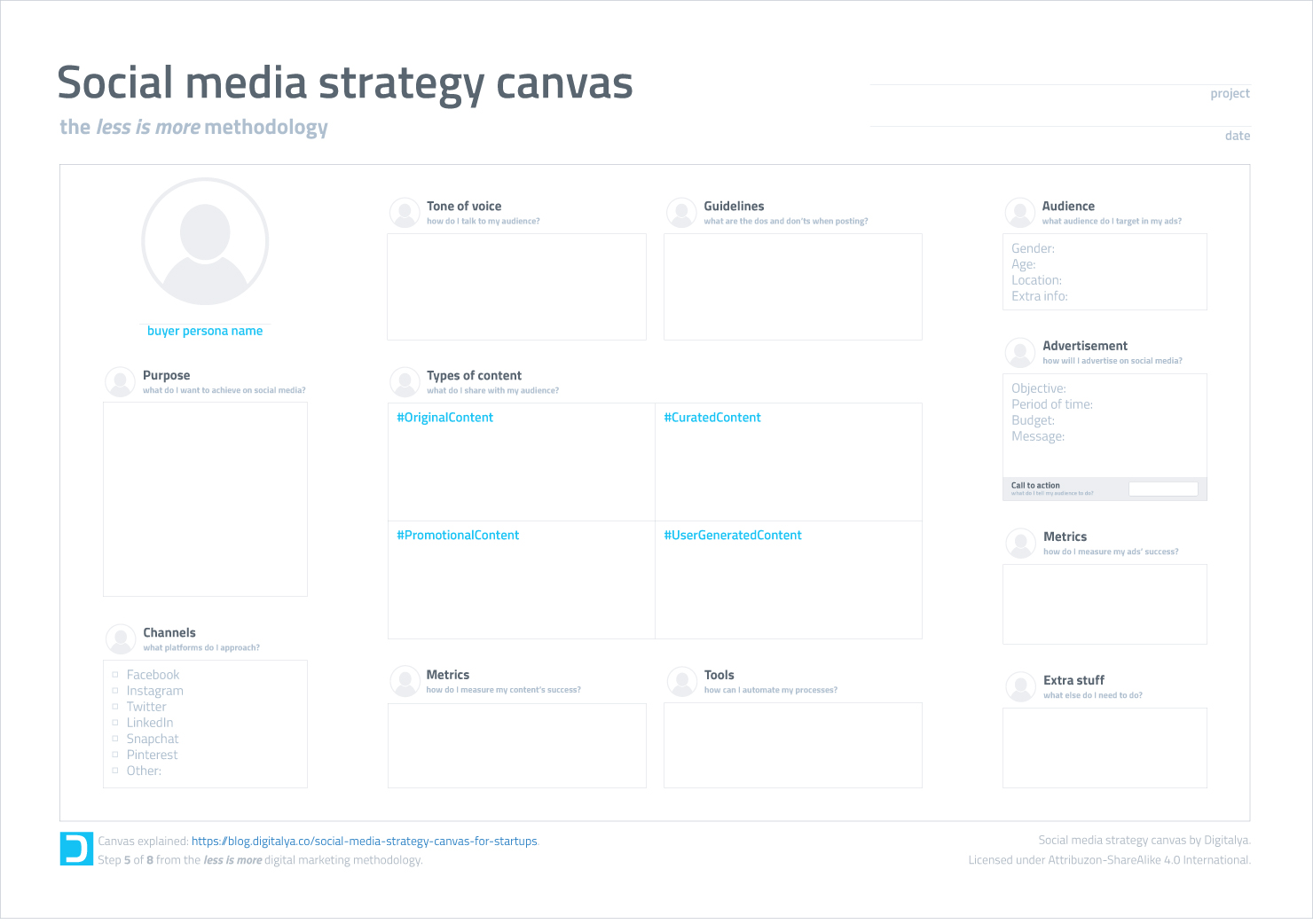
Note: This is the fifth step in our Less is More digital marketing strategy, so be sure to check out our previous articles.
Well… shall we start?
2. How do I start a social media strategy for a startup?
When thinking about social media marketing for startups there are some clear steps that you can follow:
1. Define the social media goal
Any good strategy starts out with a purpose, and this one is no exception. Without setting a goal to achieve, how would we ever measure the success of our efforts and understand our conversion rates?
So figure out what your overall goal is. Afterward, you can set specific objectives in shorter periods of time that will help you reach this higher goal.
If you need some inspiration, Buffer has a great article on setting social media goals.
You can choose one or more, depending on your business. Don’t forget to take into account what your business or marketing goals are and how this strategy can help you get closer to them.
Example:
Let’s pretend we’re a starting business, and we sell a business management tool. Because we’re a new company, we’re interested in three main things:
- Getting brand awareness;
- Getting leads to our website;
- Selling our subscriptions.
2. Choose the right social media channel
There are a ton of social media platforms out there, and being on all of them is not the answer. Firstly, it would require a huge team managing to manage all those social media profiles. And secondly, your target audience is probably not present on many social media websites. According to the study made by Global Web Index, an internet user has, on average, 7.6 social media accounts.
Just think of how many accounts you have on social media – and then which ones you’re actually active on. Businesses that want you to be their customer should only target you where you’re active. The same thing applies to your business and your clients.
It’s all about knowing who your buyer is and what platforms they’re active on. In our first article of the series, which talks about how to develop a buyer persona, we also discussed “online behavior.” In order to create an effective social media strategy, you need to understand your buyer persona and create a marketing plan based on his/her needs.
If you didn’t create a customer profile, you can look at what type of audiences each social media platform has and figure out where your target market would spend its time the most. This Social Audience Guide from Spreadfast can help you out.
Example:
The channels we’ll choose are Facebook, Instagram, Twitter, and LinkedIn – because those are the social accounts where our buyer persona is active.
3. Identify your brand’s tone of voice
The voice of a brand is another topic that we’ve discussed in our buyer persona article: “The voice is an important piece in the persona marketing puzzle. It needs to transcend all media and not only appeal to your target market but be true to your brand identity.”
However, today we’re not talking about voice. We’re talking about tone of voice. According to Acrolinx, tone of voice is:
“how the character of your business comes through in your words, both written and spoken. It’s not about what you say, but rather the way that you say it, and the impression it makes on everyone who reads or hears you. ”
When defining your tone for creating the social media content strategy for your startup, you need to keep in mind the attributes of your voice and build on them. Think of the context. For instance, writing a blog post and posting on social media are two different things. While in a blog post, you’re being informative, the content on social media should be more entertaining and eye-catching.
Tone can be different from platform to platform as well. On LinkedIn, companies tend to be more professional, while on Twitter or Instagram, they usually take a more casual approach.
Example:
Our tone of voice for social media will be friendly and inspiring while offering information that is backed up by data – not presumptions.
4. Set some guidelines
In this section, you will define some “rules” that anyone that posts on behalf of your startup should follow, like a beginner’s guide. There are two kinds of guidelines you can create here:
- what should always be done;
- what should never be done.
In the first category, you can talk about what your posts should be like and what elements they should always have, whether you’re talking about always adding hashtags or keeping in line with your brand’s visual identity. Here comes in handy a discussion with the graphic designers.
In the second category, you should write what the posts should never have, whether that’s jargon, bad-quality photos, or something else.
If you want to go the extra mile, you can create an example of a great post and an example of a bad post. These guidelines will not only help you get a better feel of what your content should be like, but they will also help tremendously other people coming on board.
Example:
We want our posts to be friendly, so we’ll include emojis. For our visual content, we’ll keep in mind our visual identity. What should never be done is to share content from suspicious websites or share bad-quality photos or videos.
5. Define different types of content
Having social accounts as a business can be exhausting because it requires you to share content constantly and consistently. To avoid the “what to post today?” crisis, you need to create a content plan. If you decide beforehand what type of content you will share on social media, you will know what and when to post (plus: your audience will know what to expect from you).
Because content means a lot of things, we’ve divided the content you can share on social media into four big categories:
- Original content;
- Curated content;
- Promotional content;
- User-generated content.
Ideally, as part of your content marketing strategy, you’ll share content from all of these four categories – but it’s okay if one or two just don’t work for you, as long as you can provide enough content for your target audience. Let’s check them out one by one so you can figure out which will work for you.
I. Original content
Let’s start with the original content. This is content created by you. Personally, I think you should rely on this one the most – and you can see the benefits of that in our previous marketing article. A blog post is maybe the most popular type of original content businesses create – but you can also create images and videos, infographics, ebooks, polls, quizzes, etc. Whatever works for your business.
II. Curated content
Next, we have curated content. This is content you collect from trustworthy brands that can provide value to your audience. Here is where you decide what type of brands you want to check out and what type of content you would want to share from them. You can share posts about trending topics, posts that are in accordance with your values, events in your community, or different topics that are interesting for your target audience. You can also take a look at your competitors and see what type of content they are sharing from other brands.
III. Promotional content
Promotional content is represented by the posts you’ll create to promote your products or services. These are sort of frowned upon – and you should definitely not overdo it. Don’t post about your products daily because your audience will think you’re too salesy and dismiss you in the blink of an eye. However, occasional promotional posts have their purpose, too – and including an offer might just convince your audience to buy. You can also boost this content with paid advertising.
IV. User-generated content
Lastly, we have user-generated content—the most precious content of all – and the most difficult to procure as well. User-generated content is exactly what it sounds like – it’s content that users create related to a brand. They can either post it on their social media accounts or send them directly to the brand. Social posts created by your target market are gold because potential clients can resonate with them
This type of content is amazing because you can share it on your social platforms. And there’s nothing that people trust more than other people’s opinions. According to MOZ, online reviews impact 67.7% of purchasing decisions. If your target audience sees that other people are enjoying your products or services, then they’ll be more inclined to try them out as well.
In this section, you can think about the type of content that your clients would be willing to create and think about how you can persuade them to share their experience with your product or service (contests or offers work great).
Example:
- For original content, we’ll share blog articles about entrepreneurship that offer value to our audience and photos and videos with our team to show our authenticity.
- For curated content, we’ll look for blog articles from trustworthy companies in our industry, as well as business statistics that could be helpful to our buyer persona.
- For promotional content, we’ll share photos and videos with our business management tool with an attached offer to persuade the audience to sign up.
- Lastly, our user-generated content will be with entrepreneurs running their businesses with the help of our tool.
6. Find the right tools
Social media managers are blessed to have a lot of tools that help them in their daily tasks. In social media marketing, there are various tools that can be used. You could even split them in categories based on their purpose:
- Tools that schedule posts;
- Tools for design;
- Tools for writing;
- Analytics tools;
- Social listening (monitoring what people say about your brand) tools.
Because we want to keep it short, we’ll leave you with an article from Neil Patel that talks more about tools for social media marketing. If you decide you want to use tools, we highly recommend researching multiple options to figure out what works best for you.
Example:
For our visual content, we’ll use Adobe Illustrator and Adobe Photoshop. To check our grammar and spelling, we’ll use Grammarly. Finally, to create a posting calendar and to schedule posts, we’ll use Google Sheets.
7. Define your audience
And now, we’ve come to the paid advertising part of social media marketing. Paid advertising is equally as important as organic promotion, and the two go hand in hand. The reason why people love social media advertising is because it’s highly targeted. Brands can target their ads exactly to the people that match their customer profile – the people that are most likely to purchase whatever the ad is selling.
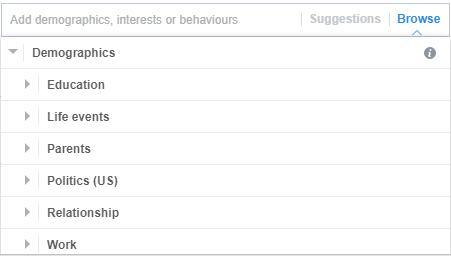
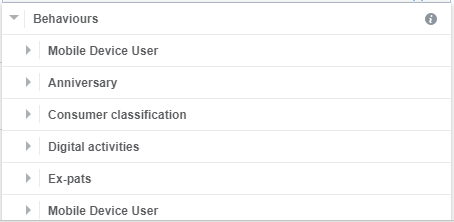
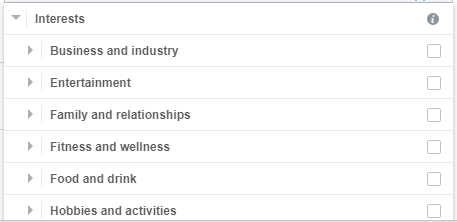
With the risk of sounding like a broken record, if you don’t have a buyer persona, this part is going to be quite difficult. If you have one already, then write down the age, gender, and location of your customers. If you have any additional information that you’d like to target, like education, job, or interests, you can include them here.
In the screenshots below, you can see the types of information Facebook allows you to target.
Example:
Our buyer persona is male, with ages between 25 and 40 years old. He lives in the United Kingdom, and his job title is founder.
8. Promote your content
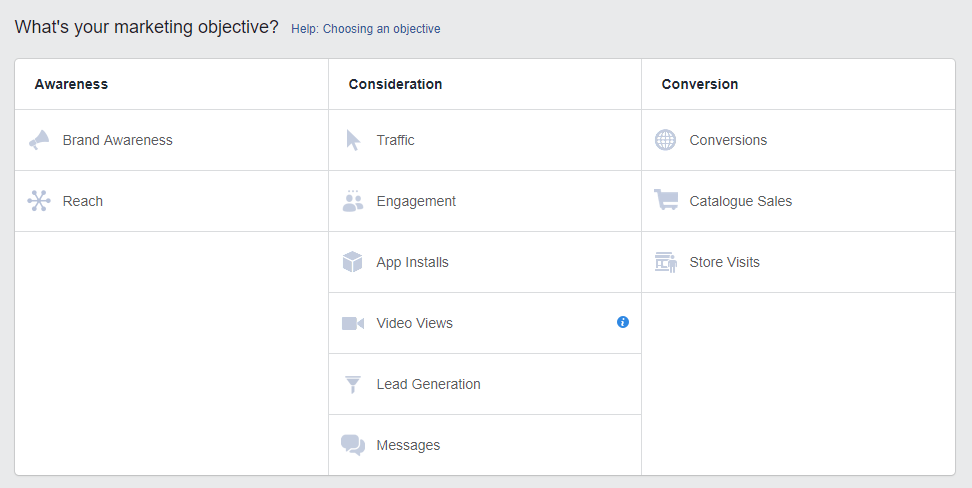
Now let’s talk about how your ads will look on social media. To figure that out, you need to set an objective based on the purpose you set earlier. Here is a screenshot of the different types of objectives Facebook suggests for its ads:
After setting your objective, you can go ahead and set up a period of time when you want your ad to run and the budget it will run on. Experiment with different periods and budgets to figure out the best combination for you.
Now, you can move on to defining the message that is going to convince your prospects to click on the ad. Depending on your overall purpose, your set objective, your product or service, and even your brand’s values – the message will be different.
As people see more and more ads, they become immune to them and get used to quickly scrolling through ads. That’s why you need to stand out; give them a reason to stop and click on your ad. Don’t forget to check if your ad provides value to your audience. This part is what makes or breaks your strategy.
There’s not much else we can help you out with here – except tell you to give yourself plenty of time to research and brainstorm the best message for you. For some extra tips, check out what Facebook has to say.
Finally, you must set what the Call to action button will say. This is directly correlated to your objective. Is my objective to get more traffic? Then my CTA should be “Click here.” Is my objective to sell something? Then my CTA should be “Buy now.” And so on…
Example:
The objective of our ad is to generate conversions. The period when it will run is 1-30 October 2018, and the budget is of 200 US dollars. The message decided for the ad is “Focus your time on what you love. Let us handle the rest”. The CTA button will say “Sign up now.”
10. Define your success metrics
After you’ve established the previous steps you need to see how you can measure the marketing strategy’s success. If something is not working out, don’t freak out. You learn by experience, especially in social media marketing. Measuring the success of your organic and paid promotion will help you tweak your strategy in order to better suit your audience’s needs. The metrics are related to both the type of content you share and the purpose you’ve set.
You can check out likes, comments, and shares to see if people engage with your content – but also verify click-through rate and revenue coming from social media to see if your purpose is being accomplished. The article we shared in the first step has recommendations of metrics for each goal they propose.
Example:
The metrics we’ll use to establish our success are the reach of our posts and referrals in Google Analytics to see how many people want to visit our website and/or buy our subscription after seeing our content on social media.
11. Customize your social channels
That was the major rundown of what you need to have as a startup for social media marketing. However, there are numerous other things you can do to improve your strategy like:
- Adding social media buttons on your website so that visitors can see your social accounts;
- Adding social sharing buttons on your blog so that people can share content they find useful;
- Create a custom profile and cover photos for your brand that you post on all social media accounts to keep consistency – this way, your audience will easily recognize you;
- Creating a plan to respond to direct messages, whether they are inquiries or complaints;
Example:
The extra stuff we need to do is:
- Add social buttons to the website and blog;
Create a profile and cover photos;
Create a plan to respond to direct messages.
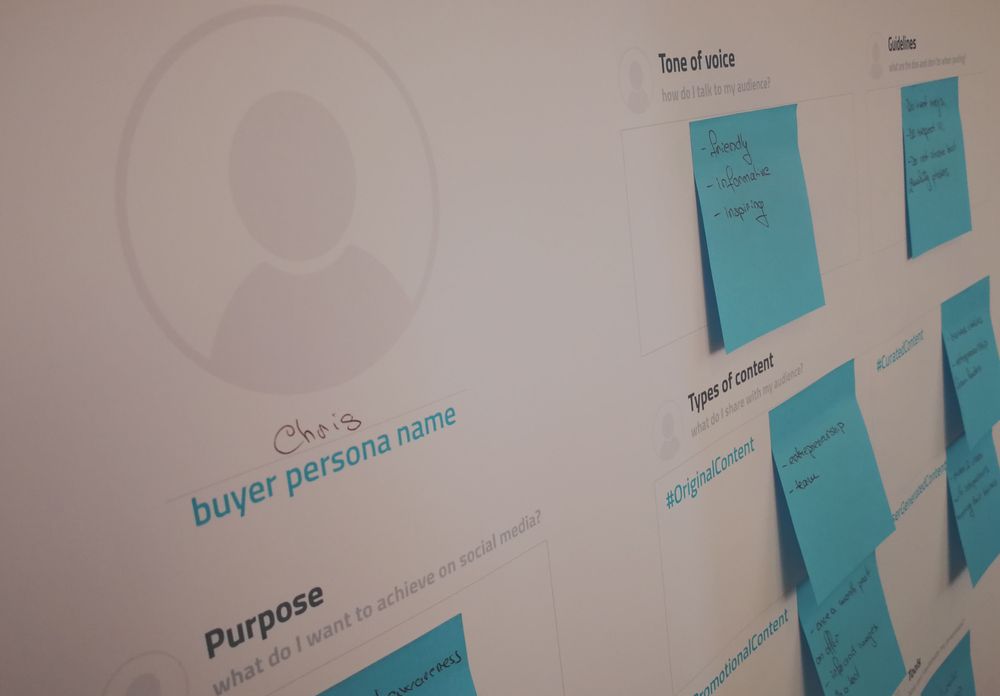
Let’s take a look at the full example on the canvas social media:
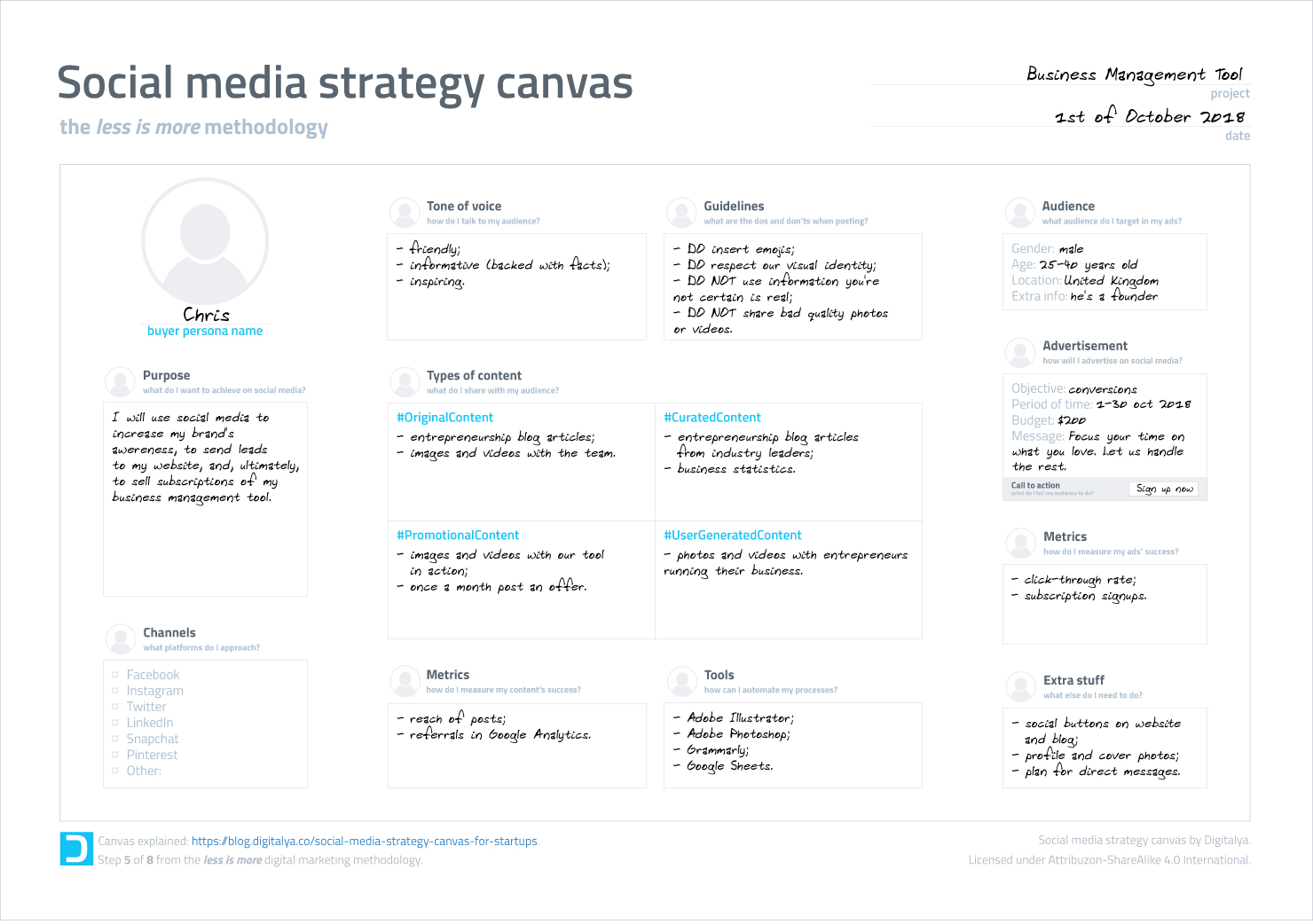
If you need inspiration, you can download the example above.
3. Canvas social media
And there you have it: a guide to understanding how to do social media marketing for startups! We hope you found the article useful and that you will use the canvas social media to create your social media plan. Don’t forget to check out our other articles and subscribe to our blog if you want to find out when we put out something new.